DC required daycare workers to get degrees. The news only talked to those who stayed.
I'm the child of a daycare worker. The women who left didn't get a story.


My mom was a daycare worker for most of my life. My best friend’s mom was one too. My childhood memories consist of many daycare workers, mostly women.
Daycare work usually pays minimum wage. The women I knew who did it for years stayed in the work because they loved it.
DC and a few other states now require daycare workers to get degrees. The research doesn’t show this improves outcomes for children below grade school level. But the requirement is there, citing it professionalizes the sector and improves quality of childcare.
The Washington Post staff wrote two pieces about DC’s decision.
One argued it’s probably a good idea. The title framed DC as a trailblazer: “D.C. among first in nation to require child-care workers to get college degrees.” It cited research that teachers need “literacy skills to introduce young learners to an expansive vocabulary.” The article focused on a daycare worker who was glad to get a degree.
The other Washington Post piece was a feel-good feature when the first class graduated.
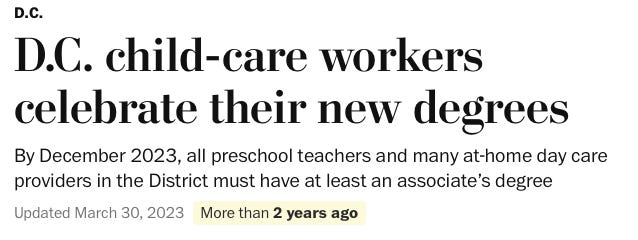
Nobody talked to the workers who left.
The media almost never runs good-news stories about low-wage work. The one time they did was celebrating a policy that pushed people out of jobs they loved.
I think the Washington Post staff mean well but it comes off as tone-deaf to workers. Government grants cover the costs of the two-year degree. But the hurdle is often that you’re asking them to do coursework in a language they’re still learning. Many daycare workers, like my mom and my best friend’s mom, struggle with English skills. This makes it hard to navigate paperwork and grant applications. A degree takes a lot of time away from other paid or unpaid work they already do.
To be told you can’t do a job you’ve been doing well for years, sometimes decades, is hurtful.
Daycare workers end up switching out of childcare work into other roles. In my circles, daycare workers pivot in and from cashier, retail, or home health. Options tend to be limited by where you can get to with limited transportation options, language skills, etc.
Formal daycare is already out of reach for many American families. Informal childcare is the most common non-parental childcare. One third to one half of employed parents of kids under five rely on friends, family, and neighbors.
Requiring daycare workers to have degrees makes what looks like a luxury good, formal daycare, even more of a luxury good. It effectively outlaws cheaper versions of daycare.
Daycare workers see this. They also see how regulations put them in impossible positions daily. If a child falls and has a bad nosebleed, rules require washing hands and putting on gloves before applying pressure. That’s minutes of a child bleeding while you grab gloves that must be stored out of reach of kids.
Research shows that U.S. upper- and middle-class voices get their preferences reprsented in government at nearly equal rates. It’s working-class voices that consistently don’t (see Vox’s deep dive on the research).
Research found that:
Bills supported just by the rich but not the poor or middle class passed 38.5 percent of the time, and those supported by just the middle class passed 37.5 percent. But policies supported by the poor and no one else passed a mere 18.6 percent of the time. “These results suggest that the rich and middle are effective at blocking policies that the poor want,” the authors conclude.
It's hard to say how much media coverage shapes which bills pass. But I notice the Washington Post staff coverage centered on the perspective of credentialed professionals and someone becoming credentialed. The daycare workers who quietly moved on to other jobs just disappeared from the story.
Coverage of this issue makes me see how working class perspectives can be left out.
"Professionalizing" a job means using credential requirements to drive out some workers to raise wages for the remaining ones. Pushing people out of these jobs isn't a bug. It's the whole point.
This feels like another instance of “well this intervention was good for me so it must be good for everyone.” It seems to pop up around higher ed more often because so often “more school” is something you’re not allowed to push back on when it doesn’t make sense.