Low-wage work is a system. Coverage treats it like specific jobs.
I spent six years in low wage work. Media and policy debates tend to flatten something that's actually quite complex. Low-wage work isn't a job. It's a whole world with its own logic and norms.


I spent six years in low-wage work. Waitressing, a call center, selling laptops at Circuit City, handing out T-shirts for a radio station.
Now I work in policy. When I read coverage of low-wage workers, it flattens something that's actually quite complex. Low-wage work isn't a job. It's a whole world with its own logic and norms. Most coverage misses that. I think that gap is costing the left politically.
Here’s what the media tends to miss.
Low-wage work is a system, not a job.
When I waited tables in Texas, I worked my way up to the coveted weekend morning shifts. Those shifts paid $90–110. Weekday evenings paid $30–40. So I filled the weekdays with other work.
A rideshare driver I recently interviewed picks up passengers during his commute to his main job managing a restaurant.
My mother was a daycare worker, a substitute teacher, and an Avon representative simultaneously.
This is how low-wage work actually functions. Workers stack income sources. They optimize each one (e.g. hours, tips, scheduling flexibility) and fill the gaps with others. Gig work isn’t a separate economy.
Media coverage usually treats fast food workers, gig workers, and home health aides as three separate populations with three separate problems.
Workers switch jobs constantly—and across sectors.
The turnover rate in low-wage work is roughly one job per year to eighteen months. Workers don’t just change employers. They change sectors.
The women around me moved between daycare, home health aide, cashier, and retail depending on who was hiring, which manager was tolerable, and which shift fit around their kids. Those latter three jobs (plus fast food or counter work) are the four occupations that make up 29 percent of all employment paying under $15 an hour.
Gender shapes the options. Women are 67 percent of workers earning minimum wage or less, concentrated in home care or childcare work. Men in my community more often went to the oil fields, manual labor, construction, mechanic shops. These jobs typically pay at the upper end of minimum wage or above it.
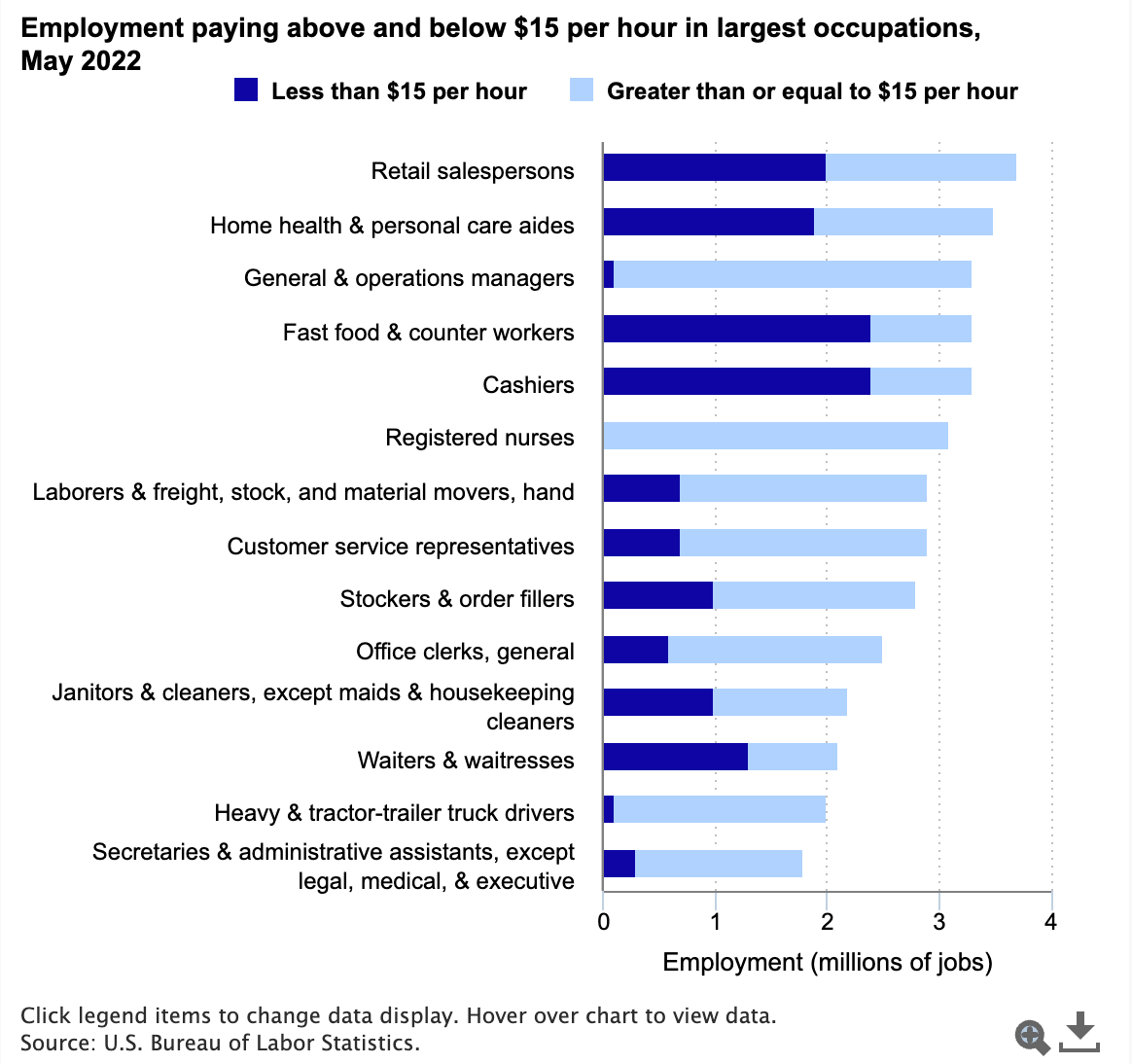
These aren’t separate labor markets. They’re one ecosystem with a lot of internal movement.
Large employers aren’t obviously the villains.
The dominant media frame is that large corporations exploit low-wage workers while small businesses are clearly preferable. Workers don’t really see it that way.
A friend worked at a small food stall. When it closed, the owners didn’t pay his last two weeks. Recovery took months.
When Circuit City shut down, I was paid for my last shift without any effort on my part. The corporate structure meant there was someone to complain to. It also meant the media would care if they didn’t. Journalists pay attention when the employer is a recognizable name.
If anything, the common complaint about large employers is that they’re selective. Small businesses are more willing to hire someone with no experience. I didn’t get a Starbucks offer until I had years of waitressing behind me.
Large employers aren’t the bottom of the labor market. They’re something workers must work up to.
The media's framing doesn't match what workers actually experience.
The reasons people stay are more complicated than the narrative allows.
Some people are stuck in low-wage work for concrete reasons: no reliable car, no childcare, limited English, a past record.
But others stay because of preference. Some people genuinely like hands-on work. Some prefer not to manage others even when offered the chance. Some have anxiety about school or uncertainty about careers.
Pretending these personal factors don’t exist doesn’t help the people dealing with them. It just makes the coverage feel inaccurate.
The political consequences.
Almost everyone I knew in that ecosystem was a Democrat. That’s not true anymore.
During Obama’s first term, Democrats represented 81 of the poorest quarter of congressional districts. Republicans held 30. By 2024, those numbers had flipped: Republicans held 65, Democrats 46.
A lot of factors drove that shift. But one of them, I think, is that working-class don’t feel seen in media or policy circles.
Consider the push for a $15 minimum wage for fast food workers. From where I sit now, having earned more than $15 for a decade, this seems like good and fair policy.
But if I were still waitressing, it would feel almost random. Why fast food? What about the daycare worker? The warehouse people? In the logic of the low-wage system, it looks like people only get help if they happen to be in the right sector at the right moment of political attention.
Or take the push to require college degrees for daycare workers. Media coverage treats this as progress. But it only makes sense from one direction: college-educated parents looking at daycares, not the women working in the daycare. For many workers, it's a pink slip.
I wrote about how daycare regulations drive up costs last week. Someone told me I was distracting from the fight against corporate power.
I know this pushback is well-meaning. But a $100 reduction in monthly childcare costs is enormous when you’re earning under $15 an hour. Dismissing it as a distraction is exactly the problem.
The left hasn’t stopped caring about working-class people. But the way it expresses that care has drifted away from how working class people talk and toward what college-educated advocates think they need.
Working-class voters noticed.
It's extremely useful to have someone with your--dare I say?--'lived experience' writing on these issues. I'm learning a lot! It's also helping me put my own current experience in context.
At this moment I have (approximately) two "gigs". One is writing data science prompts to train LLMs and it pays $80 an hour. The other is substitute teaching at local K-8 schools and it pays $15-$18 an hour. The former, vastly more lucrative job is *barely tolerable*. (In fact, I am currently choosing to write this comment for $0/hr instead of doing that job.) The kids at my vastly less lucrative job are awesome and bizarre and hilarious and I love it.
Neither of my gigs are exactly "low status" or "low wage", but relative to my old job at an Elite Academic Institution K-8 teaching is pretty close. The media, the academy, the tech world, are all full of status-conscious strivers; the idea that someone might legitimately prefer a lower-status, lower-wage job to an alternative is kinda outside that worldview.
Great piece!